Attack Interview 03 — Indicators and what to look for
What would I look for on a machine where someone opened this take-home and let the editor run its tasks? I would start with the process tree and the time of the interview, then check whether those processes made the requests the source describes. The saved Git history gives us several concrete leads.
Network references in the retained history
I scanned the committed task and auth files and decoded only URL-shaped values for AUTH_API and AUTH_API_KEY in tracked environment files. The expanded pass found 26 unique host references across both clones. I separate them by where the reference appeared and whether the corresponding loader was present in the same snapshot. These are historical indicators from source. Host availability and successful execution were outside this review.
| Evidence class | Hosts | Where the values appear |
|---|---|---|
| Editor download commands | 8 | .vscode/tasks.json, with a folder-open task and a downloader |
| Jackpot beacon | 4 | Base64 URL in a route with process.env, eval, and a repeating timer |
| Environment POST configuration | 10 | AUTH_API alongside the route constructor and controller POST |
| Other historical configuration | 4 | AUTH_API_KEY references whose connection to the same loader was unverified |
Jackpot beacon. All four addresses below appear in the route as plain HTTP on port 1224 with path /api/checkStatus.
| Address | Example Jackpot commit containing it |
|---|---|
147[.]124[.]212[.]180 |
4baa179d64bd |
147[.]124[.]212[.]207 |
f6c017386671 |
216[.]250[.]251[.]187 |
de75f7a9f040 |
216[.]250[.]252[.]245 |
3c9749cd6988, the retained head |
Editor downloads. The shared suffix is [.]vercel[.]app. The subdomains 0g-auth-check, oracle-v3-nu, and oracle-reg-check appear with /api/validate. The five subdomains ip-address-check-moa5, vscode-check-mo1, vscode-check-mo2, vscode-settings-0511, and vscode-settings-529 appear with /api/settings/mac, /api/settings/linux, or /api/settings/windows. At the retained Jackpot head the task uses vscode-check-mo2.
Environment POST. Under the same Vercel suffix, I found these /api destinations alongside the corresponding loader: api-royaljapan, api111-jade, ip-check-pc, ip-checking-notification-pic, ip-core-api-0511, ip-testcheck, ipcheck-royal, ipcheck-six, project-mjecx, and test-ip-check. Amonix’s retained head points to ip-testcheck[.]vercel[.]app/api. The four configuration-only /api/data subdomains were ake-test, astrahub, rgg-vercel, and test-g-acs.
For matching a saved copy, these are SHA-256 hashes of the exact committed route files, including their original whitespace.
| Source file | SHA-256 |
|---|---|
Jackpot 3c9749cd6988:routes/api/auth.js |
0fe2f88e19dbbb1523bb5b3d9adbf46bfa56eec5fb583ecbf04942dc5d86703a |
Amonix 82ab33b18b76:routes/api/auth.js |
28e73ce85db813ba0839ee077428eaa121037e3a1ec8a13b1171e68cc2a0accd |
What makes a useful hunt signal
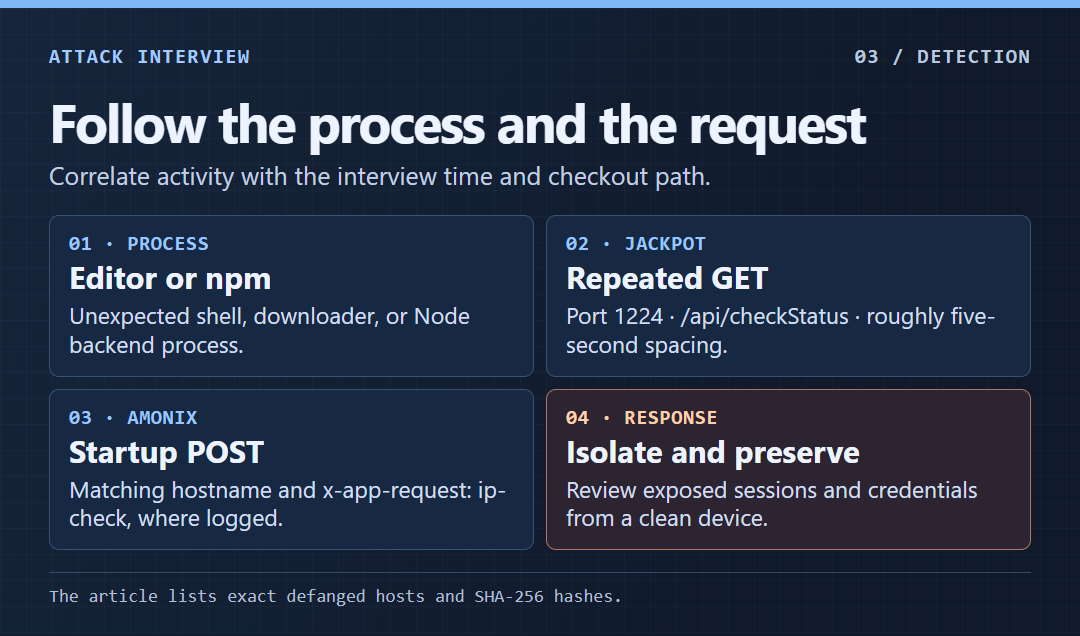
- Editor or npm process tree. Around the interview time, look for VS Code spawning a shell that launches
curlorwget, or an install spawningnode serverfrom the checkout. Correlate the parent process, working directory, command line, and destination. - Repeated outbound GETs. Look for Node contacting port
1224and/api/checkStatusat about five-second intervals, with fields namedsysInfo,processInfo,tid, andsysId. Query strings may contain secrets. Preserve them in restricted evidence storage. - An outbound POST at startup. Look for Node reaching an exact matching hostname with
x-app-request: ip-check, where your telemetry records headers. Correlate that with execution of the repository. Shared hosting makes the full hostname and path more useful than the provider domain alone.
Where it fits in the public research
Kudelski Security independently documented a related auth.js sample with the same unusual tid text, request shape, port, and status: error evaluation condition, using a different IP address. OpenSourceMalware reported the editor-task delivery pattern. These are concrete overlaps with activity tracked as Contagious Interview. Unit 42 documented BeaverTail and InvisibleFerret in that campaign. My local evidence establishes the loaders in these snapshots. Operator identity and any downloaded second stage remain unverified for this case. Kudelski’s technical analysis · OpenSourceMalware’s VS Code research · Unit 42 campaign research · MITRE ATT&CK G1052
If one of the execution paths may have run, isolate the device and involve your security team. Record the repo and revision, interview time, and actions you took. Revoke exposed sessions and rotate accessible credentials from a known-clean device. Include source control and cloud access in that review, since developer credentials can reach beyond the laptop. For a new take-home, verify its origin independently, inspect its workspace and lifecycle settings first, and use a disposable environment without work credentials if execution is required. Atlassian’s guidance for candidates and responders
In this series · 01 — The recruiter and the borrowed Git history · 02 — What could run before the login screen